
Alcohol addiction — known in Hindi as sharab ki lat or madakta — is one of the most common yet most overlooked health challenges in Odisha today. If you or someone you love is struggling to control their drinking, this guide will help you understand what is happening, why professional help matters, and how the right alcohol de-addiction treatment in Odisha can change everything.
Alcohol Addiction in India & Odisha: The Numbers That Matter
Before exploring treatment options, it helps to understand the scale of the problem. Alcohol use disorder is far more widespread than most families realise — and Odisha is not immune.
| Statistic | What It Means |
| 16 crore+ | Indians consume alcohol regularly |
| 5.7 crore+ | Indians are alcohol-dependent (NIMHANS) |
| Odisha | Among top states in eastern India for alcohol consumption |
| Only 2.6% | Of alcohol-dependent Indians access professional treatment |
| 18–28 yrs | Average age of onset of alcohol dependence in India |
| 50%+ | Of people with alcohol dependency have a co-occurring mental health condition |
These numbers point to one difficult truth: millions of people in India are trapped in alcohol dependency, and the vast majority never receive professional help. If your family is searching for an alcohol de-addiction center near you in Odisha, you are already doing more than most.
What Is Alcohol Addiction? Understanding the Disease
Alcohol addiction — clinically called Alcohol Use Disorder (AUD) — is not a matter of weak willpower or poor character. It is a chronic brain condition in which the brain’s reward, stress, and self-control systems are progressively altered by heavy alcohol use.
Over time, a person with AUD becomes physically and psychologically dependent on alcohol. Stopping suddenly can cause severe, even life-threatening withdrawal symptoms — which is precisely why medically supervised detox at a professional de-addiction centre is so important.
| “Alcohol addiction is a medical condition, not a moral failure. Just as we would not blame someone for developing diabetes, we must not blame those who struggle with alcohol dependency. The right response is compassionate, expert treatment.” |
Warning Signs of Alcohol Addiction to Watch For
Many families miss the early signs of alcohol dependency because alcohol use is socially accepted and often normalised. Here are the key warning signs that professional alcohol addiction treatment may be needed:
|
Early warning signs• • Drinking more than intended, or for longer than planned • Failed attempts to cut down or stop drinking • Spending a lot of time drinking or recovering from drinking • Craving alcohol strongly when not drinking • Alcohol use interfering with work, family, or daily responsibilities • Continuing to drink despite relationship or health problems caused by it • Building tolerance — needing more alcohol to feel the same effect • Experiencing withdrawal symptoms: sweating, shaking, nausea, anxiety when not drinking |
|
Advanced warning signs — seek help immediately• • Blackouts or memory loss during or after drinking • Drinking first thing in the morning to manage shakes or anxiety • Hiding alcohol or lying about how much is consumed • Aggression, violence, or extreme mood swings linked to drinking • Physical health deterioration: liver pain, jaundice, weight loss • Suicidal thoughts or self-harm linked to alcohol use |
Alcohol Withdrawal: Why Medical Supervision Is Essential
One of the most dangerous misconceptions about alcohol addiction is that a person can simply ‘stop on their own.’ For someone with moderate to severe dependency, abrupt alcohol withdrawal can cause:
• Severe anxiety, tremors, and sweating within 6–24 hours of last drink
• Seizures — which can occur 24–48 hours after stopping and can be fatal
• Delirium Tremens (DTs) — a severe medical emergency causing confusion, hallucinations, and cardiovascular instability
• Extreme psychological distress including paranoia and depression
This is why every alcohol de-addiction programme at STEPS Foundation begins with medically supervised detoxification. Our doctors and clinical team monitor the patient round the clock, using appropriate medications to ensure withdrawal is safe, manageable, and as comfortable as possible.
Alcohol De-Addiction Treatment at STEPS Foundation, Odisha
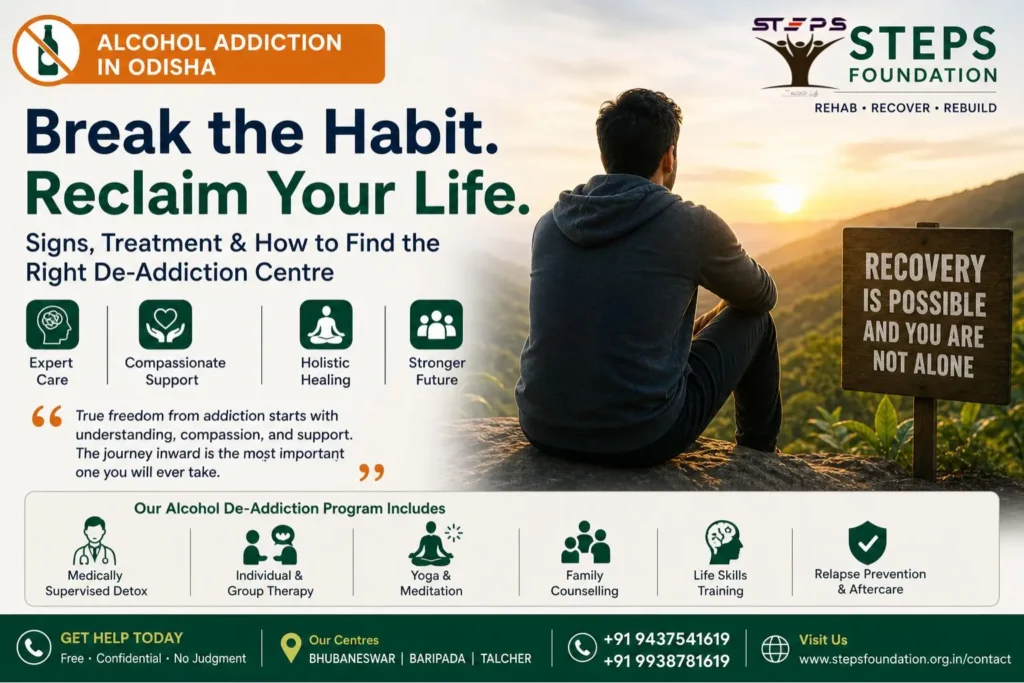
STEPS Foundation offers comprehensive, evidence-based alcohol addiction treatment at our centres in Bhubaneswar, Baripada, and Talcher. Our approach is holistic — meaning we treat the whole person, not just the drinking.
|
What our alcohol rehab programme includes• • Free confidential assessment and personalised treatment planning • Medically supervised alcohol detox — safe withdrawal with 24/7 clinical care • Individual counselling to understand triggers, trauma, and root causes • Group therapy — the power of peer support in recovery • Cognitive Behavioural Therapy (CBT) to change thought patterns behind drinking • Yoga and meditation for stress management and mind-body healing • Family counselling — because recovery affects the whole family • Life skills training — rebuilding routines, work readiness, and relationships • Structured aftercare and relapse prevention planning • Dedicated women’s wing at our Bhubaneswar centre |
| “We have seen people rebuild their careers, restore their families, and reclaim their health after years of alcohol dependency. Recovery from alcohol addiction is not just possible — it is happening every day at STEPS Foundation.” |
The 4 Stages of Alcohol Recovery
Understanding the journey ahead helps patients and families set realistic expectations. Here is a simplified view of what alcohol addiction recovery typically looks like:
| Stage | Phase | Focus |
| Stage 1 | Detox (Days 1–7) | Medical stabilisation, supervised withdrawal, managing physical symptoms safely |
| Stage 2 | Early Recovery (Weeks 2–4) | Beginning counselling, addressing underlying emotions, building daily structure |
| Stage 3 | Core Rehabilitation (Weeks 4–12) | Therapy, skills building, family work, yoga and holistic practices |
| Stage 4 | Aftercare & Relapse Prevention | Ongoing support, outpatient follow-up, and long-term recovery planning |
Why Relapse Does Not Mean Failure
One of the hardest things for families to understand is that relapse — returning to drinking after a period of sobriety — is a common part of the recovery process, not a sign that treatment has failed. Research shows that relapse rates for alcohol use disorder are similar to those of other chronic health conditions like diabetes and hypertension.
What matters is not whether relapse happens, but how quickly a person returns to their recovery plan. At STEPS Foundation, our aftercare programmes are designed specifically to reduce the risk of relapse and to provide immediate, non-judgmental support when it does occur.
If someone you know has relapsed after completing treatment elsewhere, please do not give up. Call us — a structured return to care works.
A Message for Families in Odisha
If you are a parent, spouse, sibling, or child of someone with alcohol addiction, you are probably exhausted. You have probably tried everything — pleading, hiding bottles, pouring alcohol down the drain, threatening to leave, staying silent. None of it has worked, and you blame yourself.
Please hear this: alcohol addiction is not your fault, and it is not theirs either. It is a disease. And like any disease, it needs treatment — not punishment, not shame, not more waiting.
Families that get involved in treatment — through family counselling, education, and support — dramatically improve their loved one’s chances of lasting recovery. At STEPS Foundation, we welcome families as partners in the healing process.
| “The bravest thing a family can do is ask for help. Not for themselves — for the person they love. That single phone call has changed thousands of lives in Odisha.” |
How to Admit a Loved One to an Alcohol De-Addiction Centre
Many families are unsure how the admission process works. At STEPS Foundation, it is straightforward and compassionate:
• Call us on +91 9437541619 or +91 9938781619 for a free, confidential conversation
• Our team will ask a few questions about the situation — no judgment, no pressure
• We will recommend the right level of care based on severity and circumstances
• A family member or the individual themselves can visit any of our three centres for an assessment
• On admission, our medical team takes over — families can breathe and trust the process
We understand that families sometimes need to act quickly — in cases of severe intoxication, violent behaviour, or medical emergency. Our team is available to guide you through urgent situations as well.
Frequently Asked Questions About Alcohol Rehab in Odisha
Q: How long does alcohol addiction treatment take? Duration depends on the severity of dependency. Most residential programmes run 30–90 days. Severe or long-standing dependency may benefit from longer stays. Aftercare continues beyond discharge. |
Q: Is treatment at STEPS Foundation confidential? Yes — completely. All consultations, admissions, and records are handled with full confidentiality. We never share information with employers, community members, or extended family without consent. |
| Q: Can a person be admitted without their consent? In cases where someone is a danger to themselves or others due to addiction, families can consult our team about the legal and ethical options available. We handle such situations with care and expertise. |
| Q: What is the cost of alcohol de-addiction treatment in Odisha? Costs vary based on duration and programme type. STEPS Foundation offers affordable treatment compared to similar centres, with genuine value — medical care, therapy, yoga, meals, and aftercare included. Call us for a transparent fee discussion. |
Get Help for Alcohol Addiction Today — STEPS Foundation
Free confidential consultation | Bhubaneswar | Baripada | Talcher
Call: +91 9437541619 | +91 9938781619